1. Check for power lines before you go near the tree
If a tree has brought down a power line, or is resting on one, stay away from the tree and anything it touches. Huntsville Utilities tells residents not to approach a downed power line or try to drive over it, and to call right away at 256-535-4448.
Treat every downed line as live. Lines can be hidden under leaves and branches, including the service line that runs to the house. Do not try to move limbs off a line yourself, and keep children and pets away from the area until the utility has made it safe.
2. Make the area safe and keep people out
If there is any chance a line is involved, stay back and follow step 1. Otherwise, look at what the tree is resting on and what else could still fall. Alabama Cooperative Extension's post-storm guidance starts with that question: what could a damaged tree hit if it fails? Buildings, roads, power lines and, above all, people are the targets. A tree with a target has to be managed, Extension says, and the larger the tree, the sooner it needs attention.
Keep people off decks, patios and driveways under damaged trees until the risk is dealt with.
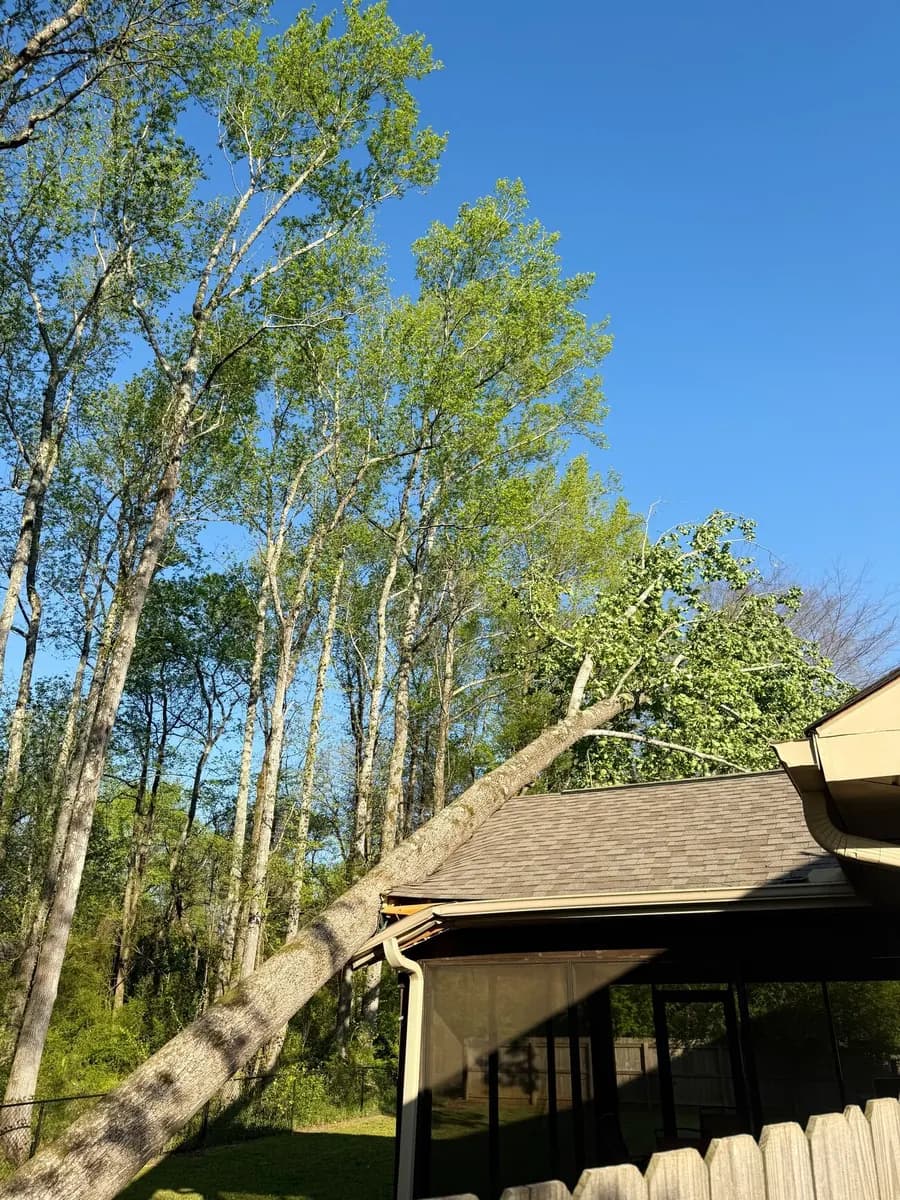
3. Take photos before anything is moved
From a spot where you are standing safely, away from any line and out from under damaged trees, photograph the tree, what it hit, and any damage to the house, fence, car or roof. Take photos from several angles before cleanup starts. Photos show the situation as the storm left it, which is useful when you talk to your insurance company and when you get estimates.
4. Look at the trees that are still standing
The tree that fell may not be the only problem. Alabama Cooperative Extension points out that some of the worst storm damage happens below ground, where wind and wet soil break or pull roots free. Look from a distance, and do not stand under a cracked or leaning tree. Warning signs:
- A tree that is leaning now and did not lean before the storm.
- A mound of soil at the base on the side opposite the lean, especially with cracks in it. Extension's guidance treats a lean with mounding as a tree to remove right away.
- Cracks in the trunk or where large branches join it. Extension calls every crack a major problem that needs immediate attention, because cracked trees can fail at any time. In most cases, it says, these trees need to be removed.
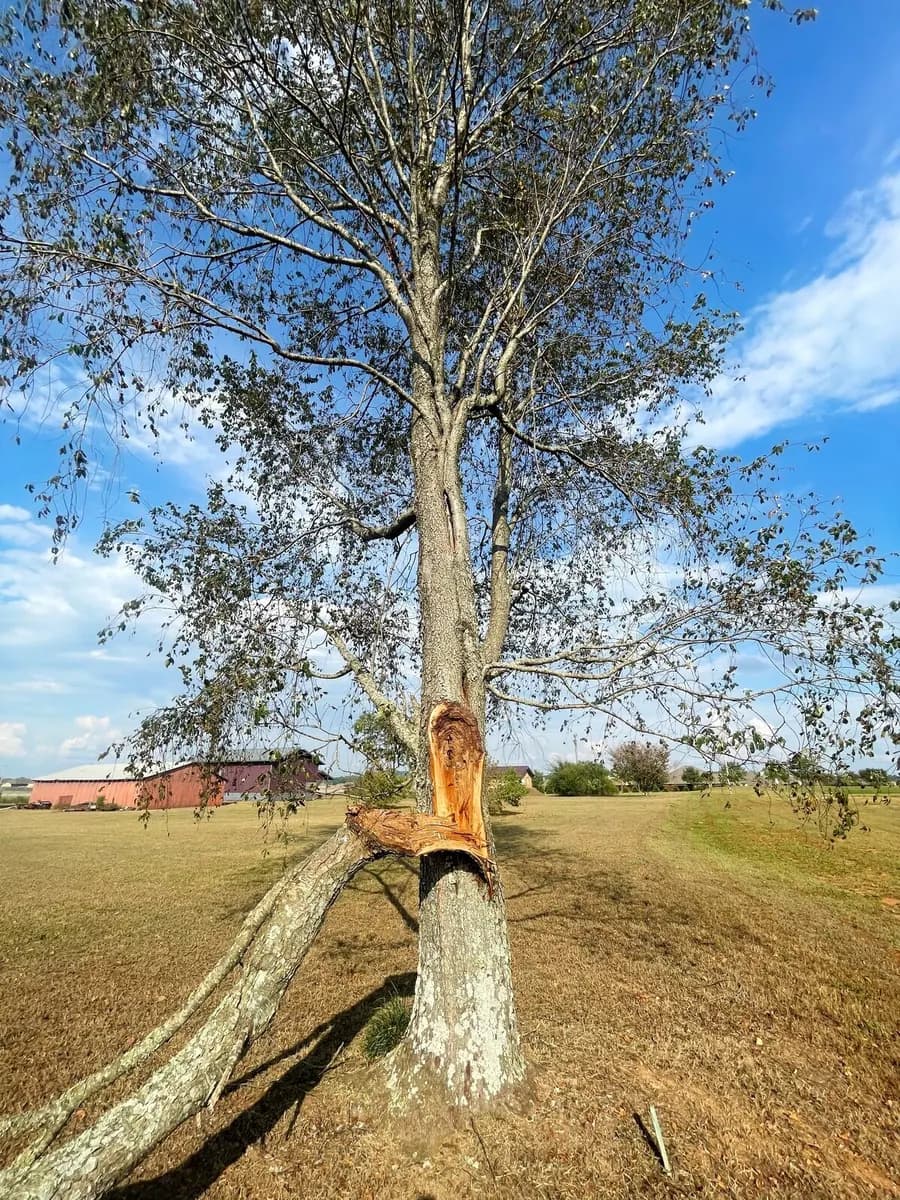
5. Decide what can be saved
Some damaged trees recover. The Alabama Forestry Commission's sheet on evaluating storm-damaged yard trees uses a rule of thumb: whether at least half of the tree's crown is still intact. A tree with less than half of its crown left may not recover. A tree whose trunk is split, that was already weakened by disease, or that has lost more than half of its crown has lost its survival edge.
For a borderline tree that is not a hazard, the Forestry Commission suggests having the broken limbs pruned and then giving the tree time before deciding, rather than cutting it down in a hurry. It notes that a tree professional may be needed for trees with damage that is too close to call.
6. Be careful who you hire after a storm
The Alabama Forestry Commission says: "Don't hire just anyone who shows up at your door following a storm." Whoever you hire, get a written estimate that spells out what is being removed, how the crew will protect what is underneath, and who hauls the debris away.
7. Plan for the debris
A fallen tree produces a lot of wood and brush. If you live inside the City of Huntsville, its curbside rules say the city collects tree limbs up to 5 feet long, and up to 10 cubic yards at no charge. The same rules say the city will not pick up debris resulting from a contractor's work. If a tree service does the removal, make sure the estimate says whether hauling the debris away is included.
Under those rules, debris goes behind the curb, not in the road, in the gutter, on top of storm drains or next to utility poles. If you live outside the city, check your own town or county's collection rules.
Getting help with a storm-damaged tree
We take down storm-damaged trees across Huntsville and nearby North Alabama, with the removal plan and cleanup written down before the work starts. You can contact us or read more about storm-damaged tree removal.
When you contact us after a storm, tell us where the tree fell, what it is resting on and whether a power line could be involved. If a power line could be involved, call Huntsville Utilities first, as in step 1. If it is resting on a structure or blocking access, call rather than filling in a form. After one storm cleanup, a customer wrote that the crew was "quick and efficient despite the magnitude of the work" and added: "What they promised, they delivered."
Common questions
- Who do I call if a tree is on a power line in Huntsville?
- Huntsville Utilities, at 256-535-4448. Do not approach the tree or the line, and do not try to move it yourself.
- Can a tree that lost big branches in a storm be saved?
- It depends. The Alabama Forestry Commission's rule of thumb looks at whether at least half of the crown is still intact. A split trunk or more than half the crown gone means the tree has lost its survival edge.
- Will the city pick up tree debris after a tree service cuts the tree up?
- Inside the City of Huntsville, the curbside rules say the city does not pick up debris resulting from a contractor's work. Ask whether haul-away is part of your estimate.
- Should I take photos before the tree is removed?
- Yes. From a safe spot, photograph the tree and any damage from several angles before cleanup starts, so you have a record for your insurance company and for estimates.
Sources
- Huntsville Utilities, Report a Problem (outage and downed line number)
- Huntsville Utilities, Power Outage Update (downed power lines)
- Alabama Cooperative Extension System, "Caring for Trees: Post-Storm Assessment"
- Alabama Forestry Commission, storm-damaged tree evaluation sheet (ESDLT050511)
- City of Huntsville, Curbside Collection