Start with where the tree stands
The City of Huntsville's tree ordinance supplies the rules below, and they apply only inside Huntsville city limits. If your home is in Madison, Athens, another town or unincorporated Madison County, check with that city or the county before relying on anything here.
The ordinance divides trees inside the city into three groups. On private land, it says "Trees located on private land are the property and responsibility of the owner of such land." Public land is the second group, defined as city land "including platted rights-of-way or streets and alleys." The ordinance leaves federal, state and county land out of that group unless the city has taken on its maintenance. The third group is "easement-laden land," which means private land where an easement has been granted for public services such as utilities, water or drainage.
A tree by the street or below a power line may fall into the second or third group, even when it looks like part of your yard.
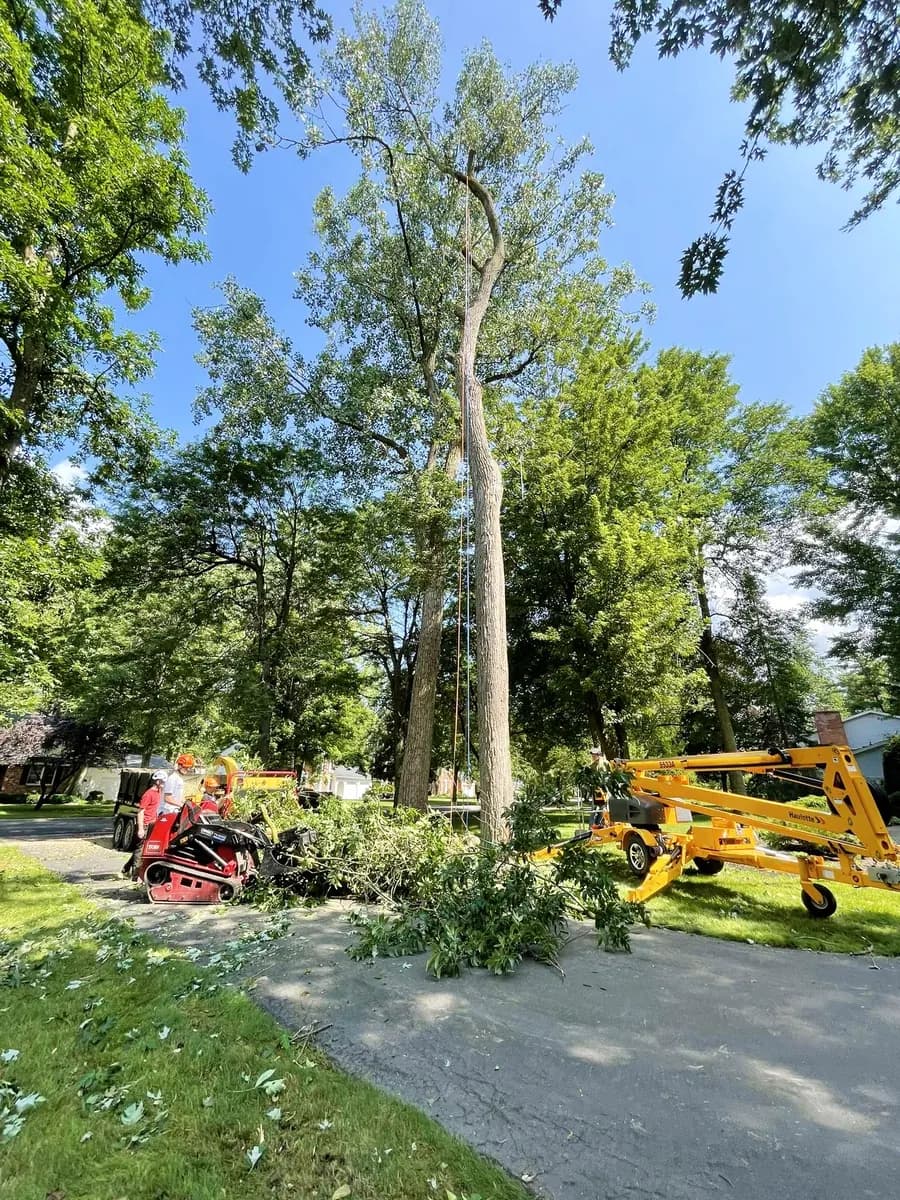
Trees in the public right-of-way
Inside Huntsville, the ordinance says "Any person or agency, private or public, needing to remove a tree six inches or more in d.b.h. from public land shall first obtain by telephone a removal permit from the city forester." Those permits "shall be issued at no cost." The permit also brings a replanting duty. Anyone who removes such trees by permit "shall provide for the planting of new trees in approximately equal numbers and in appropriate locations mutually agreed upon by the city forester and the person obtaining the permit."
D.b.h. means diameter at breast height. The ordinance measures trunk circumference 4½ feet above the ground on the uphill side, then divides by 3.14. A six-inch tree comes to a trunk about 19 inches around at that height.
The city's arborist, Marc Byers, is the contact for these trees at (256) 427-7499. A City of Huntsville article about his work says "If someone wants the City to remove a tree in the public right-of-way, they must go through his office to acquire a tree removal permit." Trees planted by the city in a street right-of-way cannot be removed "except by a duly authorized person, company, organization, or agent of the city who has first secured a permit from the city forester."
The ordinance also assigns a duty to owners whose land adjoins public or easement-laden land. If a tree you maintain "is, or is likely to become, a threat to the public safety," it is your duty to deal with the hazard. If a tree wholly on private property is not dealt with and the city does the work, "the cost of the city's abating the hazard shall be assessed against the property owner."
Outside the city, Madison County Public Works helps the County Commission manage activities within the unincorporated county right-of-way and easements. Its right-of-way page does not address trees, so check with the county before cutting near a county road.
What a utility easement means for tree removal
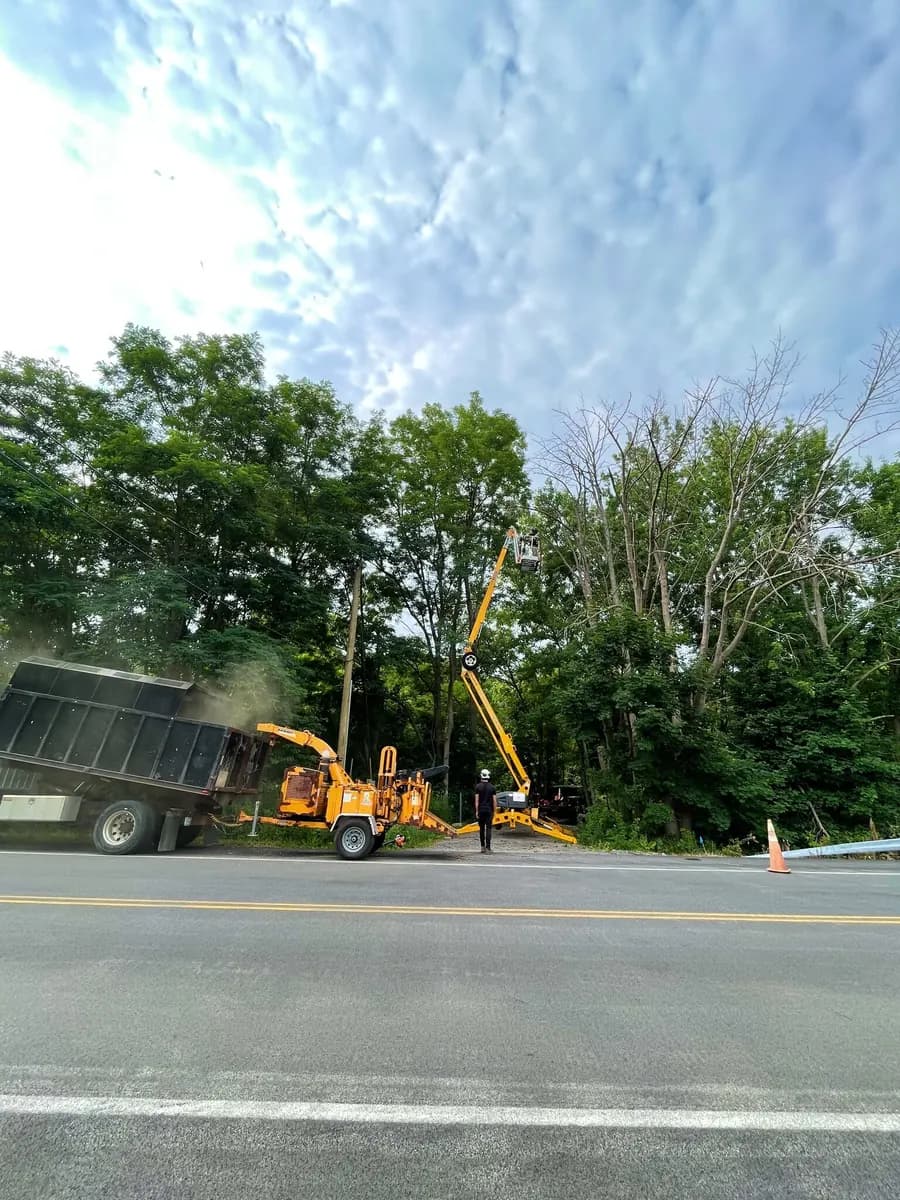
Huntsville Utilities defines an easement as "a privilege to pass over the land of another, whereby the holder of the easement acquires only a reasonable use of the property, and the owner of the land retains the benefits and privileges of ownership." You still own the land, and someone else holds a right to use part of it.
Inside the city, the ordinance says "Trees on easement-laden lands are the property and responsibility of the owner of the land on which the easement lies." It also says "All removal or maintenance work involving such trees shall be conducted in accordance with the tree care standards adopted herein." Its list of offenses covers trees on public and easement-laden land, so check with the city arborist before removing a tree inside an easement.
Your survey or closing papers may show where easements run across your lot. If you are unsure, ask the utility or the city office that holds the easement before scheduling the work.
Trees near power lines
If a tree grows into or toward a power line, start with your power company. For Huntsville Utilities customers, its line clearance program says "Trees growing along the side, into, or toward electric power lines or utility space shall be trimmed." It adds that "Trees directly under and growing into electric power lines should be removed or trimmed." Its planners leave a door hanger that explains the work, and questions go to its Line Clearance office at 256-535-1224 or trees@hsvutil.org.
Huntsville Utilities also tells customers "Do not try to trim a tree that is in a power line." If a line is already down, it says never to touch or move it and to call 256-535-4448.
Under its line clearance program, Huntsville Utilities says customers who have trees removed on their property are eligible for a tree replacement voucher and stump grinding, but only for street-side trees. The utility says this "does not include trees in a back yard or trees removed as a result of a specific customer request."
Our tree removal work includes technical removals near roofs, fences and utility lines. When a tree is touching a line, call the power company first.
Before stump grinding, contact Alabama 811
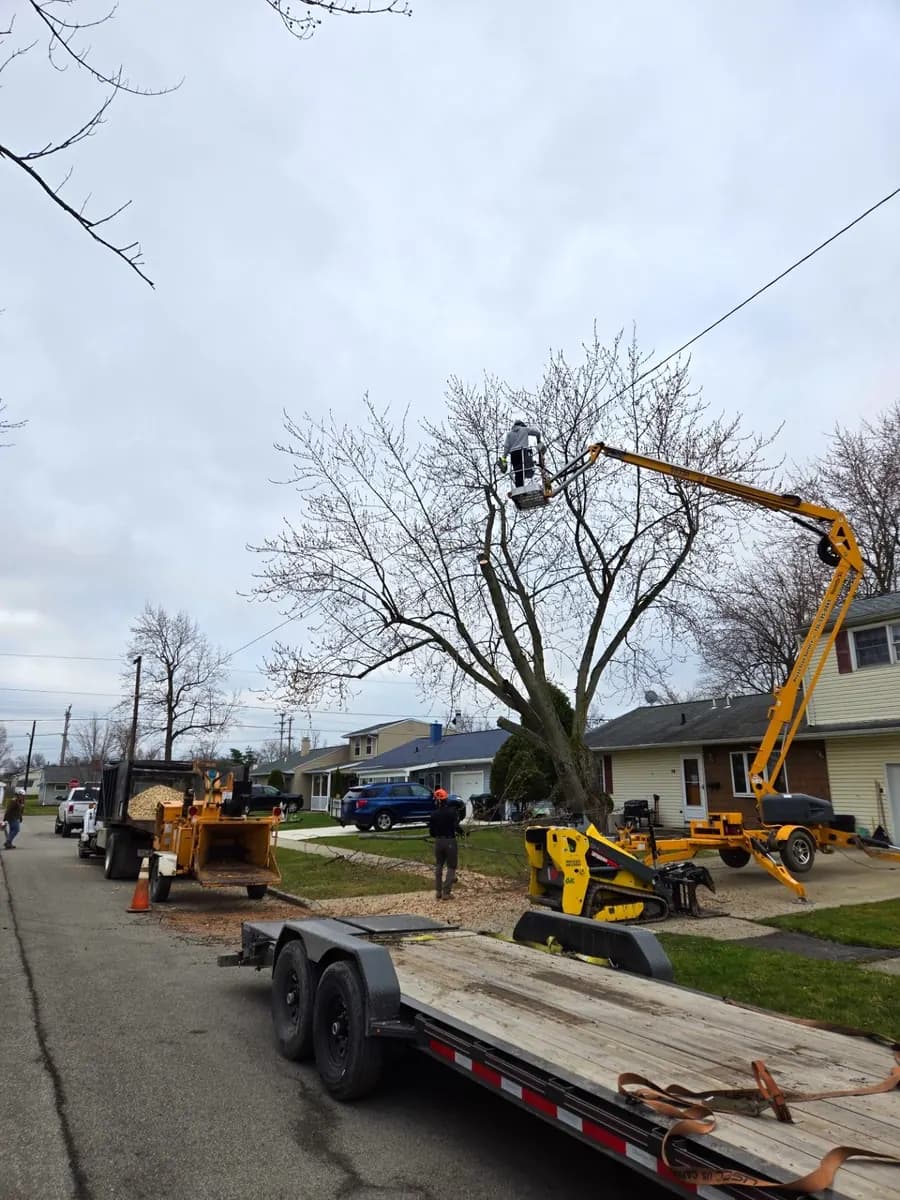
Stump grinding reduces the stump below grade, which means the work goes below the surface of the ground. Alabama 811 tells homeowners to contact it "at least two business days before digging to have utilities marked" and says "It's free, it's simple, and it's the law." Alabama law sets the notice at "at least two but not more than 10 working days" before excavation starts, not counting the day you give notice.
You can call 811 or submit a request online. Utilities mark their lines with paint or flags, and Alabama 811 describes a tolerance zone of at least 18 inches on each side of a marked utility. Before the machine starts, ask whoever grinds your stump whether a locate request is in place. See stump grinding versus root removal and our stump grinding service for what grinding removes.
HOA rules and historic districts
Many subdivisions have covenants covering trees, and those rules vary by neighborhood. Read your association's rules, or ask the association in writing, before scheduling the work.
Huntsville has four locally designated historic districts: Twickenham, Old Town, Five Points and Alabama A&M University. The city says that in a historic district, "all projects that result in exterior changes to buildings or their settings are required to obtain a Certificate of Appropriateness (COA) or Expedited Staff Review approval." Its published list does not name tree removal specifically. The commission's design review guide says "The removal of existing trees with a base circumference of 20 inches or more is not recommended unless the tree is diseased, has been extensively damaged, or is dead." If your home is in one of these districts, call the Historic Preservation Office at 256-650-4779 before any tree comes down.
A short checklist before the crew arrives
- Confirm whether the property is inside Huntsville city limits or under another city or the county.
- Find out whether the tree stands on your lot, in the right-of-way or inside an easement.
- Look up for power lines, and call your power company about any tree in or near one.
- Plan a locate request with Alabama 811 before any stump is ground.
- Check HOA covenants and historic district rules if either applies.
When we are asked to remove a tree, we look at its condition, lean, surrounding structures, equipment access and the planned path for debris. You receive a free estimate and a clear explanation of what will be removed, how the crew will approach it, and what cleanup includes. One customer wrote that "They informed us of everything that would be done."
Read more about tree removal in Huntsville, see what changes a tree removal estimate, or request a free estimate.
Common questions
- Do I need a permit to remove a tree in my yard in Huntsville?
- Inside city limits, the ordinance says trees on private land are the owner's property and responsibility, and its permit rule covers trees six inches or more in d.b.h. on public land such as the right-of-way. If the tree is in the right-of-way, inside an easement or in a historic district, check with the city arborist or the Historic Preservation Office first. Outside the city, check with your own city or the county.
- Can the city remove a tree in the right-of-way in front of my house?
- Inside Huntsville city limits, for a right-of-way tree that the adjoining owner maintains, the ordinance says such trees "shall not be removed by the city without notice of the adjoining owner," except where notice would get in the way of safe traffic, street work, utilities or drainage.
- Who trims a tree growing into a power line?
- Start with your power company. If that is Huntsville Utilities, it says trees growing into or toward its lines shall be trimmed, and it takes questions at 256-535-1224. Do not trim near the line yourself.
- Do I need to call 811 before a stump is ground?
- Alabama 811 says to contact it at least two business days before digging so utilities can mark their lines. Grinding works below grade, so ask whoever grinds the stump whether a locate request is in place.
Sources
- City of Huntsville, "Code of Ordinances, Chapter 27, Vegetation, Article II, Trees"
- City of Huntsville, "Trees" (Urban Forestry and Horticulture)
- City of Huntsville, "Going out on a 'limb' for public safety in Huntsville"
- Huntsville Utilities, "Tree Trimming and Line Clearance"
- Huntsville Utilities, "Safety Zone"
- Huntsville Utilities, "Request to Vacate Easement/Right-of-Way (ROW)"
- Madison County, "Right-of-Way Management"
- Alabama 811, "Homeowner Guide: Contact 811 Before Digging"
- Alabama 811, "Before You Dig"
- Code of Alabama, "Section 37-15-4, Notice of Intent to Excavate or Demolish"
- City of Huntsville, "About Us" (Historic Preservation)
- City of Huntsville, "How to Apply" (Historic Preservation)
- Huntsville Historic Preservation Commission, "A Guide to Design Review in Huntsville's Historic Districts"