Start with what the tree could hit
Extension defines a hazard tree by three things: the chance that the tree or part of it will fail, the conditions around it, and whether there is a target. A target is a person or object that could be hurt or damaged. Without one, Extension says, a tree cannot qualify as a hazard.
Houses, fences, cars and people are common targets. A house is always there if a tree fails, while a person is unlikely to be under a tree in a corner of the yard nobody uses. Extension also says risk can go down when the target is moved, such as taking a picnic table or trampoline out from under a tree you are unsure about.
Warning signs in the roots
Most of a tree's roots are out of sight. Extension's homeowner guide describes two kinds of root failure: waterlogged soil combined with high winds can loosen the soil's hold on the roots, or the roots can be cut, decayed or damaged.
Cut roots can be easy to miss, so pay attention to work done near the tree:
- Recent construction inside the tree's dripline (the area under the outer edge of the branches)
- A new sidewalk or driveway close to the trunk
- Trenching for buried utilities or irrigation lines
- A tree growing close to a house foundation
The crown can also point to root trouble. Extension notes that a thinning canopy, or dead branches at the top of the tree or the tips of its branches, can point to cut, decaying or diseased roots.
Signs of root decay at the base of the tree include mushrooms or conks (fresh or old), carpenter ants, oozing wounds with a sour smell, loose or missing bark, and open cavities or voids.
Warning signs in the trunk
A leaning tree does not always fall. Extension says some leaning trees remain stable for a long time, often with branches that have adjusted to the lean, but it calls a lean that is getting worse quickly a warning sign of impending failure. Soil mounded on the side opposite the lean points to a critical root problem, and a tree that has recently shifted from upright needs immediate action.
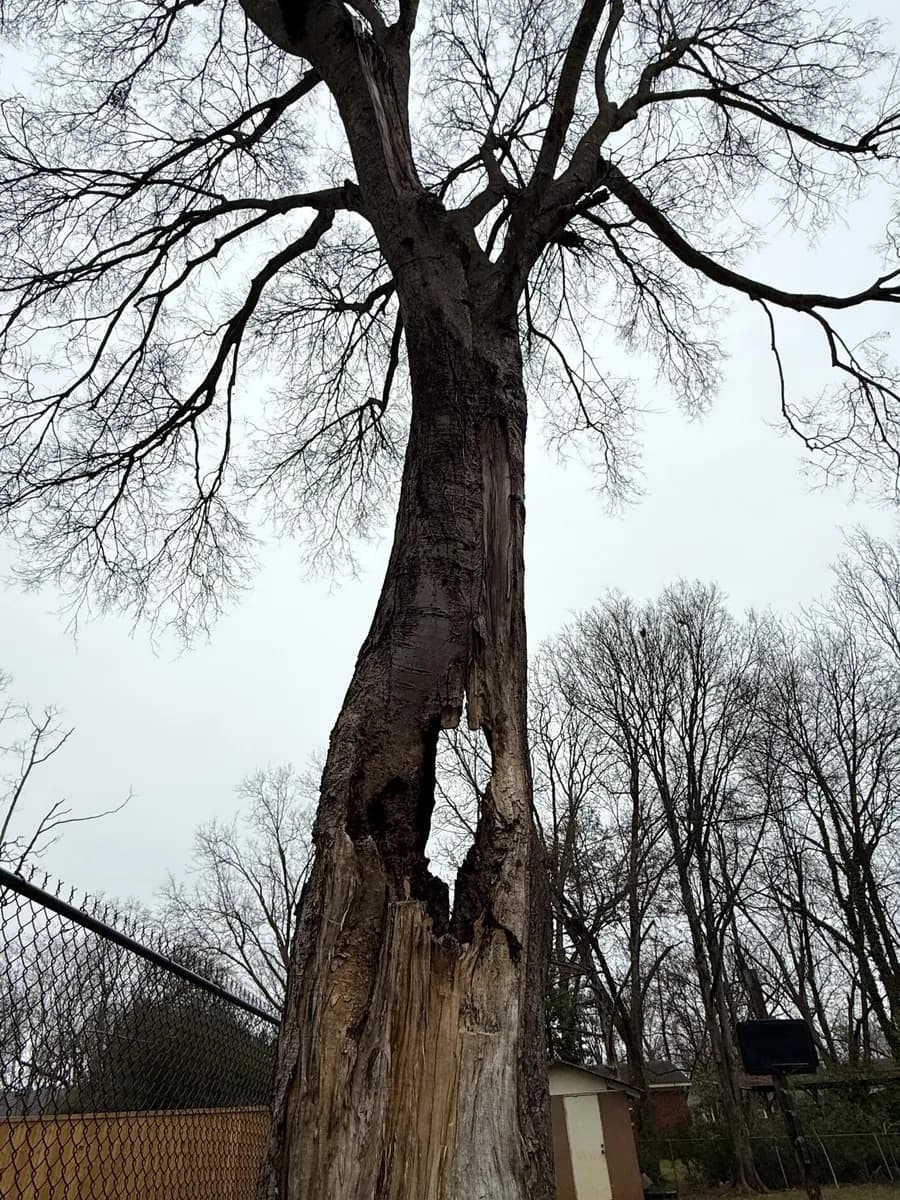
For cracks, Extension's rule is that the deeper and longer the crack, the greater the risk. A crack needs immediate action when it runs deep or all the way through the trunk or a branch. The same is true when it sits opposite or connects to a decayed area or cavity, or appears with several other cracks in the same part of the tree.
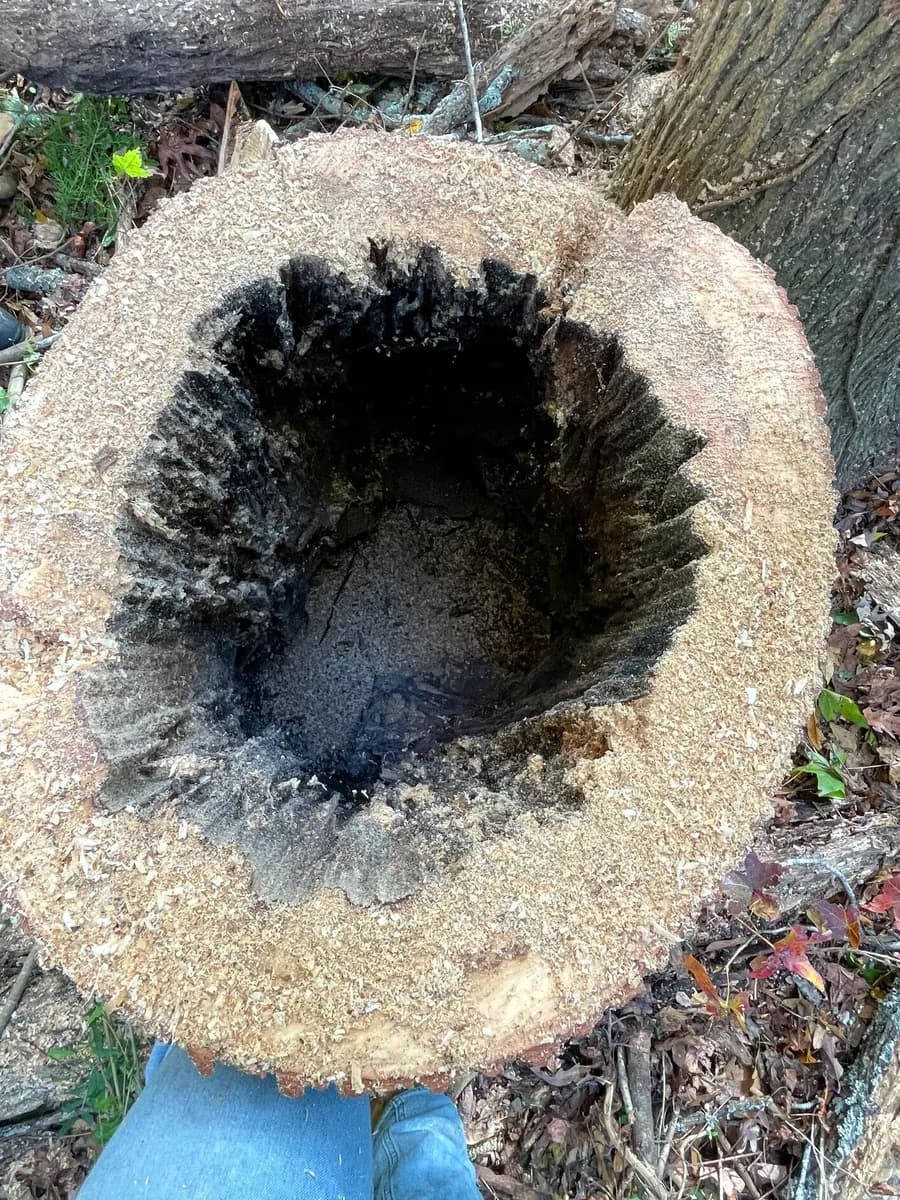
Most trees have some decay, Extension says, and the size and location decide the risk. A large cavity, or one near ground level or at the base of a major branch, is more serious. Signs include mushrooms or conks on the trunk, loose bark, cavities, carpenter ants or bees, trunk bulges and oozing openings or stains. Not every decaying tree shows mushrooms, so a clean trunk does not prove sound wood inside.
A fork where two trunks grow from one point is often weakly joined, especially when it forms a narrow V. If that joint has a crack or decay, the fork is unsafe.
Warning signs in the crown
Some deadwood is normal in every tree. Extension says more and larger deadwood raises the risk, and a dead branch or tree with a target underneath should be removed as soon as possible. Some species, such as honey locust and black locust, can hold dead branches for a long time while the tree is still healthy.
Watch for hangers as well. These are limbs that have broken but remain caught in the tree, either partly attached or resting on another branch. Enough connected wood can let them keep their leaves, which makes them easy to miss after a storm.
Which signs need action now, and which can wait
These signs call for action now, and people should stay away from the tree until it is dealt with:
- A tree that has recently started leaning, especially with mounded or cracked soil on the opposite side. After storms, Extension's guidance is to remove a leaning tree with mounding immediately.
- A vertical or horizontal crack in the main trunk. Extension's post-storm guidance is to remove these trees right away.
- A large hanger over a place where people walk, park or play.
- A tree or limb touching a power line (see the next section).
These are worth having looked at soon:
- Mushrooms or conks at the base, or a cavity near ground level
- A thinning crown or dead top after construction, trenching or a new driveway near the tree
- Several dead limbs over the house, the driveway or a fence
These can usually be watched over time:
- A tree that has leaned the same way for years, with branches that have adjusted to it and no soil movement. Extension says a leaning tree still warrants a closer look.
- A few small dead branches over open ground
- A dead tree far from anything it could hit (see the questions below)
Extension recommends checking large trees once a year or after every major storm. If a storm has already brought a tree down, our guide on what to do when a tree falls in a storm covers the first steps.
Trees near power lines
If a tree is growing into or toward a power line, start with your power company. For Huntsville Utilities customers, its line clearance program says trees growing along the side of, into or toward its power lines shall be trimmed. Questions go to its Line Clearance office at 256-535-1224. Do not try to trim or cut near the lines yourself.
If a tree has already brought a line down, stay away from it and call your power company right away. Huntsville Utilities tells its customers not to approach the line or try to drive over it, and to call at 256-535-4448.
What you can check yourself, and what you should not
You can do most of the looking from the ground. Extension suggests viewing the tree from different angles, using binoculars for the upper crown, and keeping photos and notes to track whether a problem is getting worse.
Fixing the problem is different. Extension says a homeowner should do the corrective work only in the few cases where the problem is small, easy to handle and within reach of the ground. Most tree safety problems, it says, are too large, too awkward and too dangerous for a homeowner. If you are unsure what you are seeing, it recommends a qualified second opinion, especially before any corrective work, from someone with the professional experience and knowledge to assess trees for safety.
When removal is the right call
Removal makes sense when a defect cannot be fixed and the tree has something to hit. A dead, leaning, storm-damaged or badly placed tree can threaten a roof, fence, driveway or power line. When a tree is sound and the problem is a few dead or heavy limbs, tree trimming may be enough.
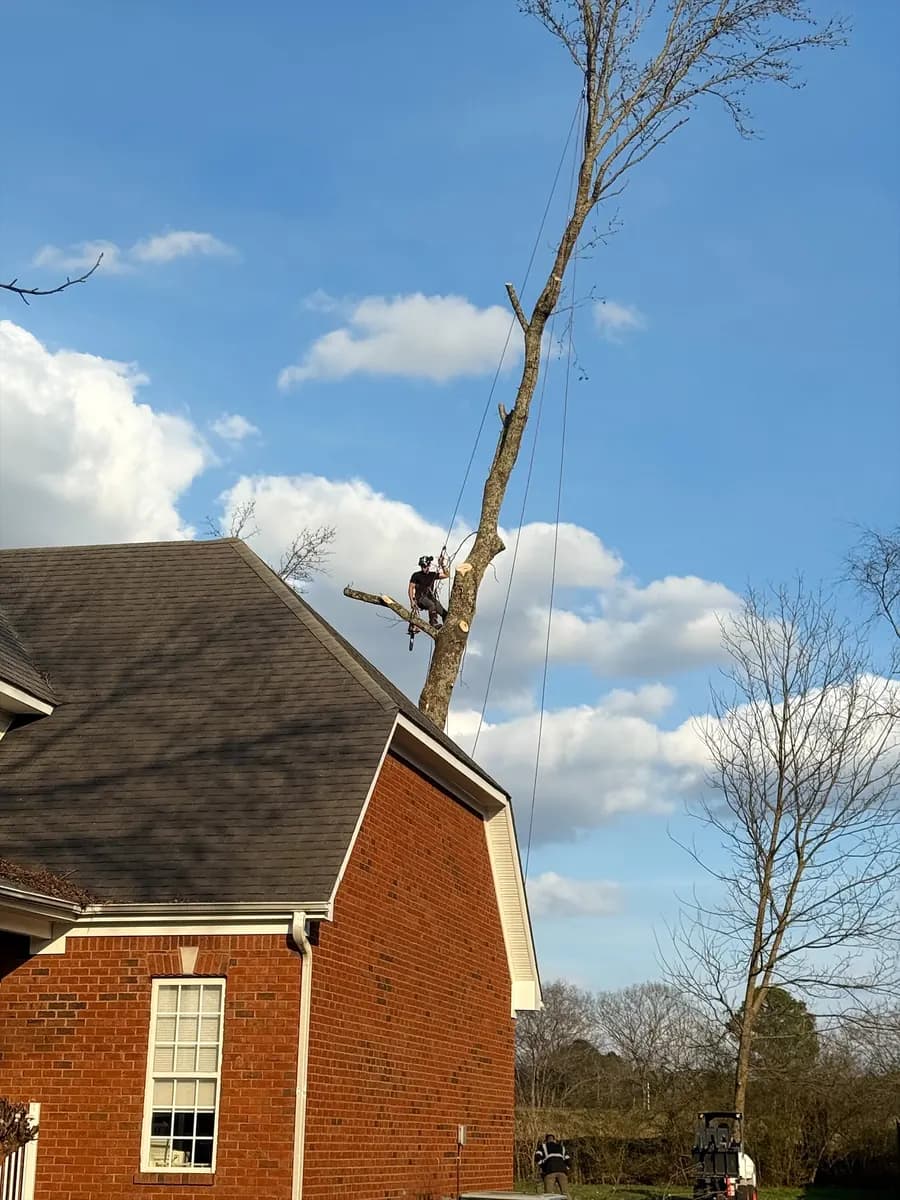
Before the first cut, we look at the tree's condition, lean, surrounding structures, equipment access and the planned path for debris. You receive a free estimate and a clear explanation of what will be removed, how the crew will approach it, and what cleanup includes. A tree near a house or fence may come down in controlled sections instead of being dropped whole. Stump grinding can be added to the estimate and is listed separately so you can see exactly what is included. The tree removal cost guide explains what moves the price.
One customer wrote after a tree removal job that the team "removed three difficult trees on a steep down hill slope" and "removed all tree debris and hauled it away."
If a tree on your property shows any of the signs above, read more about tree removal in Huntsville or request a free estimate.
Common questions
- How do I know if a tree needs to be removed?
- Look for a new lean, deep cracks, cavities, mushrooms at the base and large dead limbs. Then consider what the tree would hit if it failed. A serious defect over a house, a car or a place where people spend time is the strongest case for removal.
- Does a leaning tree always need to come down?
- No. Extension notes that some leaning trees stay stable for a long time. A lean that is new or getting worse quickly, or one with mounded soil on the opposite side, needs immediate attention.
- Are mushrooms at the base of a tree a bad sign?
- They can be. Extension lists mushrooms and conks, fresh or old, among the signs of root decay. Not every decaying tree shows them, so have the tree looked at if you see them near the base.
- Can a dead tree be left standing?
- Sometimes. Extension notes that a dead tree that poses no danger can be left in place for wildlife. If it could fall on a house, a fence, a car or a place where people spend time, it should come down.
Sources
- Alabama Cooperative Extension System, "Restoring Storm-Ravaged Trees: Step-by-Step Guide to Examining Your Tree for Safety"
- Alabama Cooperative Extension System, "Spotting Danger: How to Identify & Assess Hazard Trees"
- Alabama Cooperative Extension System, "Caring for Trees: Post-Storm Assessment"
- Huntsville Utilities, "Tree Trimming and Line Clearance"
- Huntsville Utilities, "Power Outage Update" (downed power lines)